C_ADBTP_2601퍼펙트덤프최신데모, C_ADBTP_2601시험대비덤프데모다운
Wiki Article
ExamPassdump의 인지도는 고객님께서 상상하는것보다 훨씬 높습니다.많은 분들이ExamPassdump의 덤프공부가이드로 IT자격증 취득의 꿈을 이루었습니다. ExamPassdump에서 출시한 SAP인증 C_ADBTP_2601덤프는 IT인사들이 자격증 취득의 험난한 길에서 없어서는 안될중요한 존재입니다. ExamPassdump의 SAP인증 C_ADBTP_2601덤프를 한번 믿고 가보세요.시험불합격시 덤프비용은 환불해드리니 밑져봐야 본전 아니겠습니까?
IT업계에 계속 종사하고 싶은 분이라면 자격증 취득은 필수입니다. SAP C_ADBTP_2601시험은 인기 자격증을 필수 시험과목인데SAP C_ADBTP_2601시험부터 자격증취득에 도전해보지 않으실래요? SAP C_ADBTP_2601덤프는 이 시험에 대비한 가장 적합한 자료로서 자격증을 제일 빠르게 간편하게 취득할수 있는 지름길입니다. 구매전 덤프구매사이트에서 DEMO부터 다운받아 덤프의 일부분 문제를 체험해보세요.
>> C_ADBTP_2601퍼펙트 덤프 최신 데모 <<
C_ADBTP_2601시험대비 덤프데모 다운 - C_ADBTP_2601인증공부문제
SAP인증 C_ADBTP_2601시험은 등록하였는데 시험준비는 아직이라구요? SAP인증 C_ADBTP_2601시험일이 다가오고 있는데 공부를 하지 않아 두려워 하고 계시는 분들은 이 글을 보는 순간 시험패스에 자신을 가지게 될것입니다. 시험준비 시간이 적다고 하여 패스할수 없는건 아닙니다. ExamPassdump의SAP인증 C_ADBTP_2601덤프와의 근사한 만남이SAP인증 C_ADBTP_2601패스에 화이팅을 불러드립니다. 덤프에 있는 문제만 공부하면 되기에 시험일이 며칠뒤라도 시험패스는 문제없습니다. 더는 공부하지 않은 자신을 원망하지 마시고 결단성있게ExamPassdump의SAP인증 C_ADBTP_2601덤프로 시험패스에 고고싱하세요.
최신 SAP Certified Associate C_ADBTP_2601 무료샘플문제 (Q10-Q15):
질문 # 10
SIMULATION
Enable a Cloud Foundry Environment
Add a service plan for Cloud Foundry environment and enable it in a subaccount.
Task 1: Add a Service Plan for Cloud Foundry Environment
In your SAP BTP cockpit, in your EU HCM Dev subaccount, entitle one MEMORY service plan for the Cloud Foundry Runtime.
정답:
설명:
See the Explanation below for complete solution.
Explanation:
Before you start
Log in to SAP BTP Cockpit.
Open your correct Global Account.
Go to the Human Resources directory.
Open the EU HCM Dev subaccount.
This matters because the runtime memory quota must be assigned to the EU HCM Dev subaccount specifically. SAP documents that the MEMORY plan is the quota-bearing plan for Cloud Foundry Runtime.
Step 1 - Open the EU HCM Dev subaccount
In the cockpit, choose Directories.
Open Human Resources.
Select EU HCM Dev.
You should now be on the EU HCM Dev subaccount page.
Step 2 - Open Entitlements
In EU HCM Dev, choose Entitlements.
SAP Help confirms that service plans and quota assignments for a subaccount are configured in the Entitlements area.
Step 3 - Configure entitlements
Click Configure Entitlements or Add Service Plans.
Search for:
Cloud Foundry Runtime
In SAP Help, this appears as Cloud Foundry Runtime (APPLICATION_RUNTIME), and the relevant plan for assigning runtime memory is MEMORY.
Step 4 - Select the MEMORY plan
Under Cloud Foundry Runtime, select:
MEMORY
Set the quantity to 1 if the cockpit shows an amount/quota field.
Add the plan to the subaccount.
Save the entitlement changes.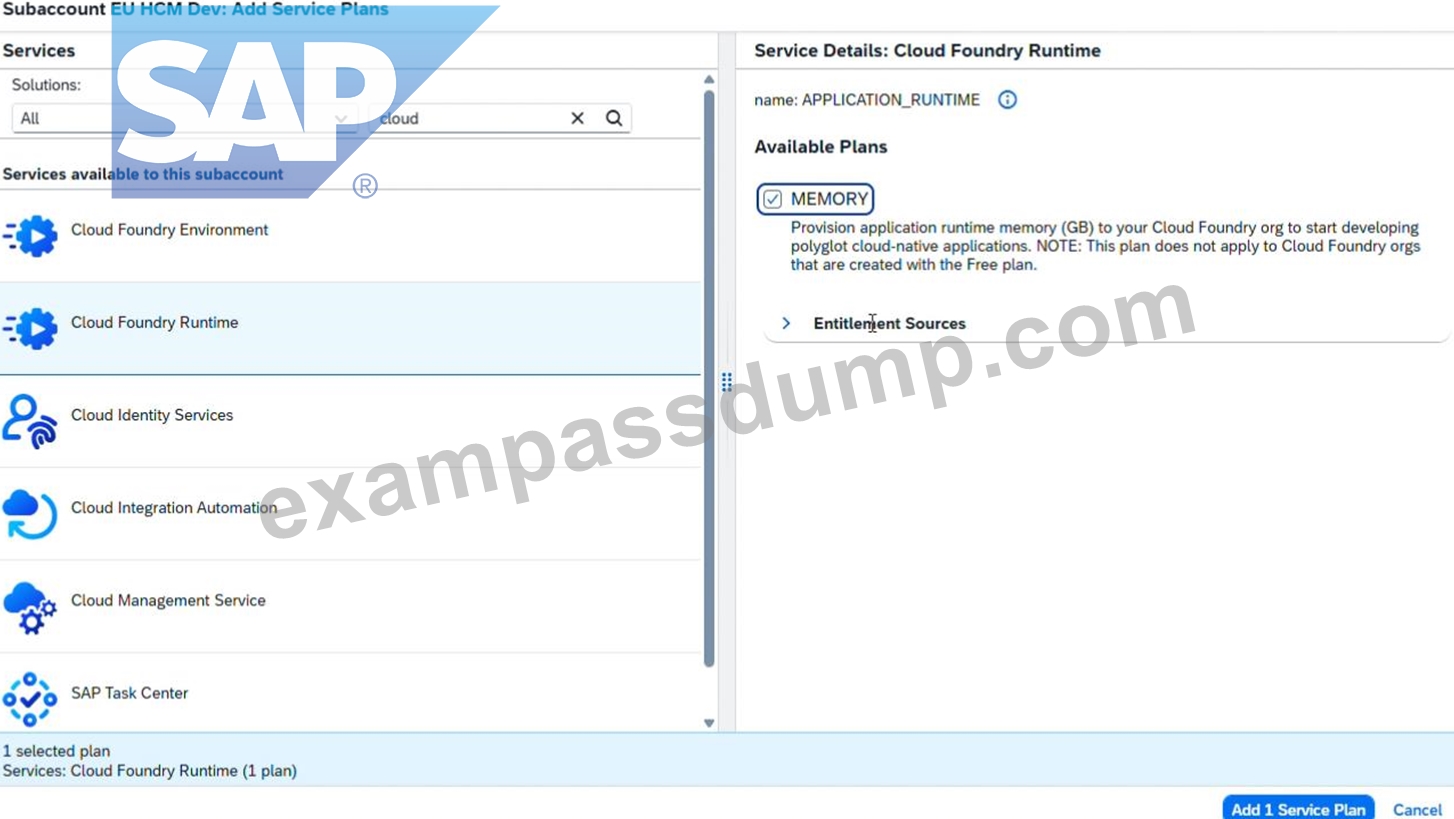
SAP documents that the MEMORY plan is specifically used to assign runtime memory quota to the subaccount, and that 1 unit corresponds to 1 GB of runtime memory when quota is adjusted or assigned.
Step 5 - Verify the result
After saving, check the Entitlements page of EU HCM Dev.
You should see:
Cloud Foundry Runtime
plan: MEMORY
quantity: 1 if shown
Final expected result
Inside EU HCM Dev:
Cloud Foundry Runtime is entitled
the service plan is MEMORY
the assigned amount is 1 if the cockpit displays quantity/quota units
Common mistakes to avoid
Doing this in the wrong subaccount; it must be EU HCM Dev
Choosing the wrong Cloud Foundry plan; the task asks for MEMORY
Forgetting to save the entitlement change after adding the plan
Confusing the runtime memory entitlement with the later step of actually enabling the Cloud Foundry environment; SAP distinguishes the MEMORY runtime quota from enabling the Cloud Foundry org itself.
질문 # 11
SIMULATION
Enable a Cloud Foundry Environment
Task 2: Enable and Configure a Cloud Foundry Environment
In your SAP BTP cockpit, in the EU HCM Dev subaccount, enable the Cloud Foundry environment in the cf-eu10-004 landscape. Set the instance name to cf-eu-hcm-dev and the org name to btpops####-eu-hcm-dev.
In the EU HCM Dev subaccount, create a space with the name activity-recording.
In the EU HCM Dev subaccount, create a space quota with the name half-org-quot a. Halve the available org quota for memory, routes, service, and instance memory for an unlimited number of app instances. Assign the space quota to activity-recording.
정답:
설명:
See the Explanation below for complete solution.
Explanation:
Before you start
Log in to SAP BTP Cockpit.
Open the correct Global Account.
Go to Directories.
Open Human Resources.
Open the EU HCM Dev subaccount.
This matters because the task must be completed specifically in EU HCM Dev. SAP documents that Cloud Foundry is enabled at subaccount level, and the system creates a Cloud Foundry org linked to that subaccount.
Part 1 - Enable the Cloud Foundry environment
Step 1 - Open the subaccount overview
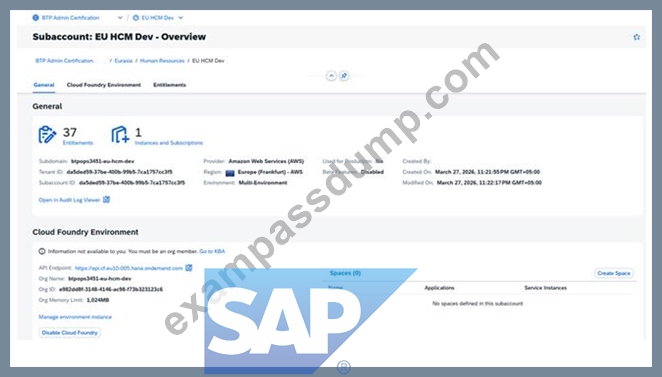
In EU HCM Dev, go to Overview.
Explanation:
SAP Help describes the cockpit flow for enabling Cloud Foundry from the subaccount Overview page.
What to verify
You should see a Cloud Foundry section on the overview page.
Step 2 - Start enabling Cloud Foundry
In the Cloud Foundry section, click Enable Cloud Foundry.
Explanation:
This starts creation of the Cloud Foundry organization for the subaccount. SAP notes that when you enable Cloud Foundry in a subaccount, the system automatically creates a Cloud Foundry org for it.
Step 3 - Enter the required Cloud Foundry values
In the enablement dialog, enter:
Landscape: cf-eu10-004
Instance Name: cf-eu-hcm-dev
Org Name: btpops####-eu-hcm-dev
Then confirm by clicking Create or Enable.
Explanation:
The task gives you the exact landscape and naming values to use. SAP documentation shows that enabling Cloud Foundry in the cockpit requires naming the Cloud Foundry instance and org.
What to verify
After the process completes, the subaccount should show Cloud Foundry as enabled, with the org created for EU HCM Dev.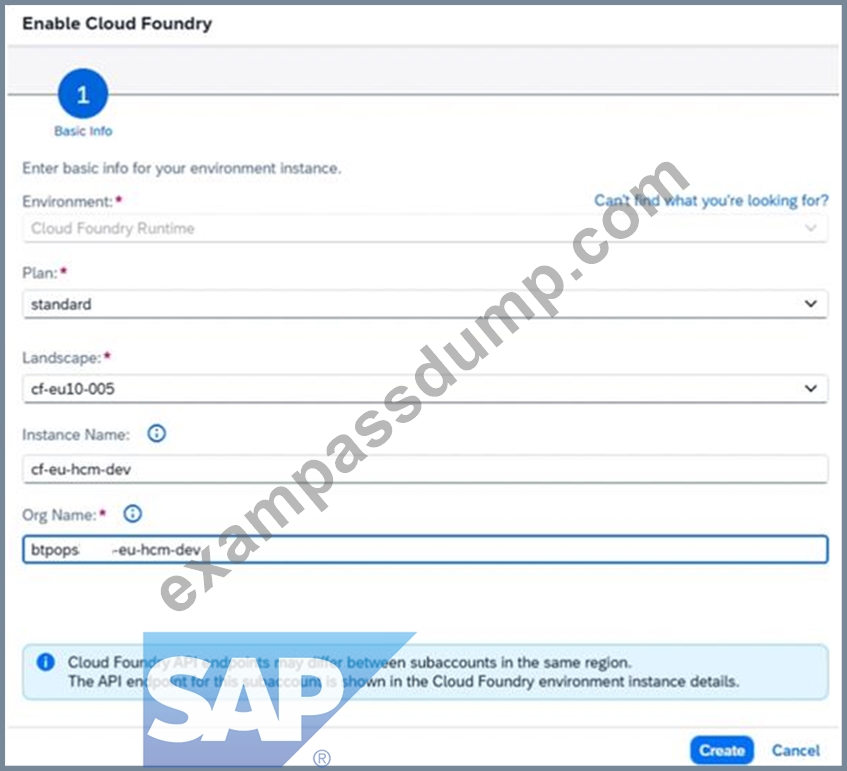
Part 2 - Create the space
Step 4 - Open Spaces
In EU HCM Dev, after Cloud Foundry is enabled, open:
Cloud Foundry
Spaces
Explanation:
SAP Help shows that spaces are created from the Spaces area after Cloud Foundry is enabled in the subaccount.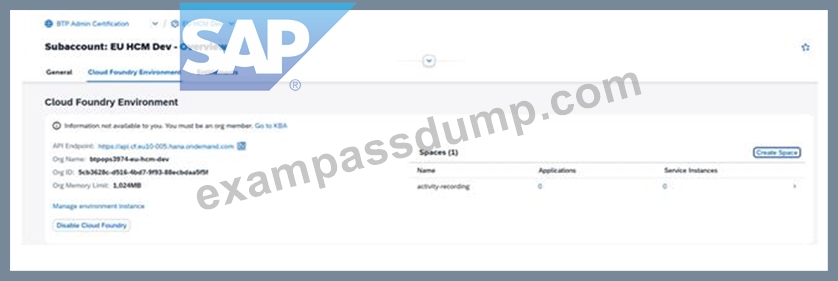
Step 5 - Create the space
Click Create Space.
Enter:
Space Name: activity-recording
Confirm by clicking Create.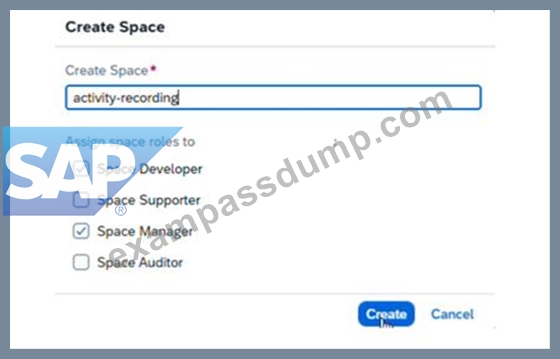
Explanation:
This creates the required Cloud Foundry space inside the org for EU HCM Dev. SAP's cockpit documentation and setup guides show this as the standard next step after enabling the environment.
What to verify
You should now see:
activity-recording
in the list of Cloud Foundry spaces.
Part 3 - Create the space quota
Step 6 - Open Cloud Foundry Space Quotas
In EU HCM Dev, open:
Cloud Foundry
Space Quotas
Explanation:
SAP Help states that, in the Cloud Foundry environment, the quotas allocated to a subaccount can be further distributed by creating space quota plans, and these are managed from the Cloud Foundry Space Quotas area.
Step 7 - Create a new space quota
Click Create Space Quota or New Space Quota.
Enter the quota name:
half-org-quota
Explanation:
This creates a quota plan that you will assign to the required space. SAP Help describes creating space quota plans in the subaccount and then assigning them to spaces.
Step 8 - Set quota values to half of the org quota
In the quota form, set the values to half of the available org quota for:
Memory
Routes
Services
Instance Memory
For App Instances, set:
Unlimited
Then save the quota.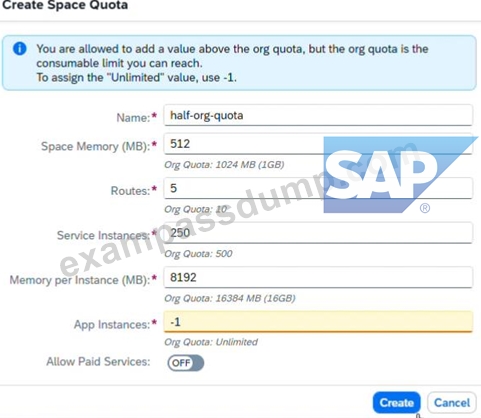
Explanation:
The simulation asks you to halve the available org quota for those four dimensions. SAP Help confirms that space quotas are used to limit resource consumption inside the org by defining values such as memory, routes, and service instances, and that these plans can then be assigned to spaces.
How to calculate "half"
Use the current org quota values shown in the Cloud Foundry quota screens and divide each by 2 before entering it.
Examples:
If org memory = 2 GB, enter 1 GB
If routes = 20, enter 10
If services = 200, enter 100
If instance memory = 2 GB, enter 1 GB
What to verify
The new quota plan should exist as:
half-org-quota
with the reduced values saved.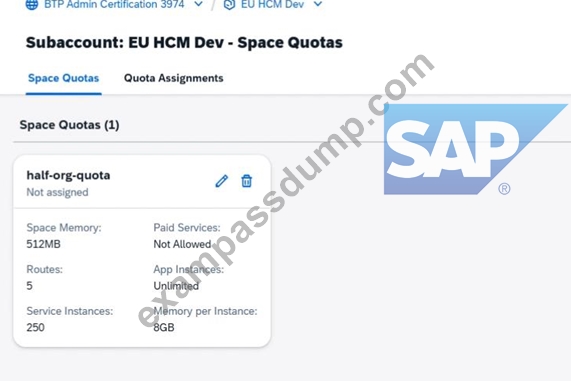
Part 4 - Assign the quota to the space
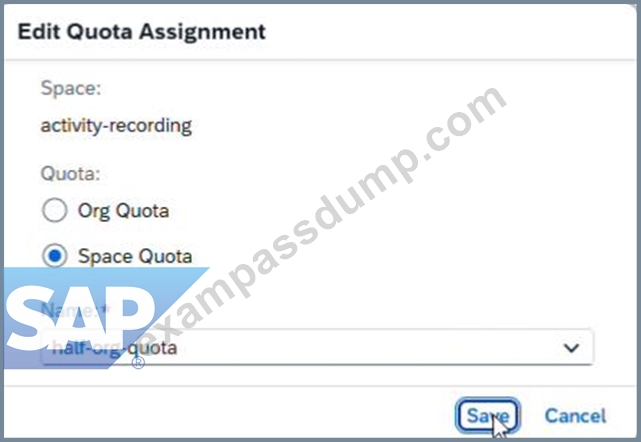
Step 9 - Assign the quota to activity-recording
Open the newly created quota:
half-org-quota
Choose Assign Spaces or Assign to Spaces
Select:
activity-recording
Save the assignment
Explanation:
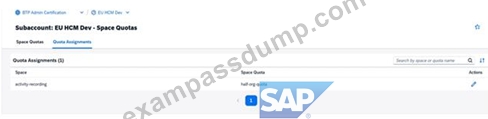
SAP Help states that after creating a space quota, you assign it to one or more spaces from the space quota management flow.
What to verify
The quota half-org-quota should now be assigned to:
activity-recording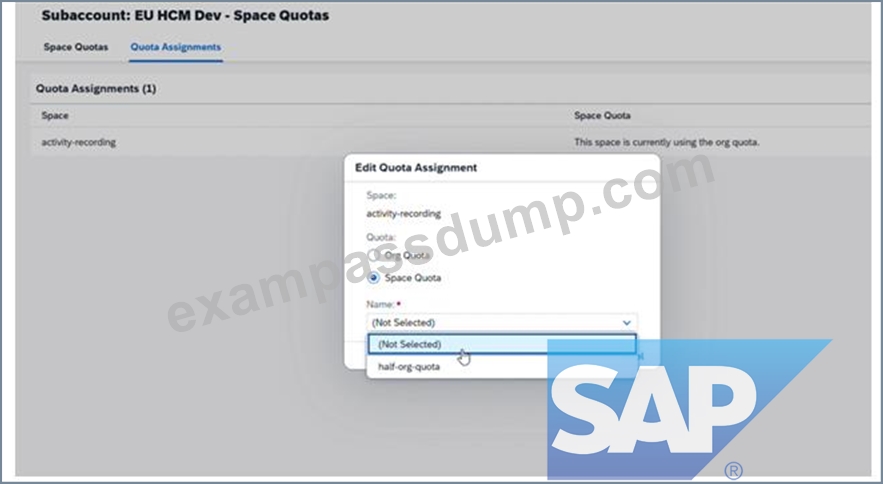
Final expected result
Inside EU HCM Dev:
Cloud Foundry is enabled
landscape is cf-eu10-004
instance name is cf-eu-hcm-dev
org name is btpops####-eu-hcm-dev
space activity-recording exists
space quota half-org-quota exists
memory, routes, services, and instance memory are each set to half of the available org quota app instances are unlimited quota half-org-quota is assigned to activity-recording Common mistakes to avoid Enabling Cloud Foundry in the wrong subaccount; it must be EU HCM Dev.
Using the wrong landscape; the task explicitly requires cf-eu10-004.
Typing the wrong org name; use exactly btpops####-eu-hcm-dev.
Forgetting to create the space before assigning the quota.
Entering full org quota instead of half.
Limiting app instances to a number instead of leaving them unlimited.
Creating the quota but not assigning it to activity-recording.
질문 # 12
SIMULATION
Task 3: Create Subaccounts with Default Provider and Region
In the Human Resources directory, create the subaccount EU HCM Dev (Description: Human Resources Development) with subdomain btpops####-eu-hcm-dev in the region Amazon Web Services (AWS) → Europe (Frankfurt) cf-eu10.2.
In the Human Resources directory, create the subaccount EU HCM Test (Description: Human Resources Testing) with subdomain btpops####-eu-hcm-test using EU HCM Dev as source subaccount.3.
In the Human Resources directory, create the subaccount EU HCM Prod (Description: Human Resources Production) with subdomain btpops####-eu-hcm-prod using EU HCM Dev as source subaccount. Set the subaccount as used in production.
정답:
설명:
See the Explanation below for complete solution.
Explanation:
You must create these 3 subaccounts inside the Human Resources directory:
EU HCM Dev
EU HCM Test
EU HCM Prod
Important:
Replace #### with your global account number
Enter names, descriptions, and subdomains exactly
EU HCM Prod must be marked as used in production
Task 3 - Create Subaccounts with Default Provider and Region
Before You Start
Log in to the SAP BTP Cockpit.
Open the correct Global Account.
Go to Directories.
Open the Human Resources directory.
Why this matters:
All 3 subaccounts in this task must be created inside Human Resources. If you create them anywhere else, the result will be incorrect.
Step 1 - Open the Human Resources Directory
What to do
In the left menu, choose Directories.
In the list, select Human Resources.
Explanation:
This is the parent directory where the required HR subaccounts must be created.
What to verify
You should now be inside the Human Resources directory.
Step 2 - Start Creating EU HCM Dev
What to do
Inside Human Resources, open Subaccounts.
Click Create → Subaccount.
Explanation:
This opens the form to create the first HR subaccount.
Step 3 - Enter Values for EU HCM Dev
What to do
Enter the following:
Display Name / Name: EU HCM Dev
Description: Human Resources Development
Subdomain: btpops####-eu-hcm-dev
Set the region as:
Cloud Provider: Amazon Web Services (AWS)
Region: Europe (Frankfurt)
Technical Region / Environment: cf-eu10
Then click Create.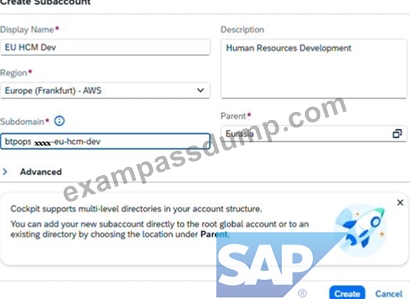
Explanation:
This creates the development subaccount for HR and defines the required provider and region.
This first subaccount is important because it will be used as the source subaccount for the next two subaccounts.
What to verify
After creation, you should see:
EU HCM Dev
under the Human Resources directory.
Step 4 - Confirm EU HCM Dev Exists
What to do
Check the subaccounts list in Human Resources.
Explanation:
You must make sure EU HCM Dev is available before you create the next subaccounts, because both EU HCM Test and EU HCM Prod must use it as the source subaccount.
What to verify
You should see:
EU HCM Dev
If it is missing, create it correctly before moving on.
Step 5 - Start Creating EU HCM Test
What to do
Still in the Human Resources directory, click Create → Subaccount again.
Explanation:
This opens the form for the test subaccount.
Step 6 - Enter Values for EU HCM Test
What to do
Enter:
Display Name / Name: EU HCM Test
Description: Human Resources Testing
Subdomain: btpops####-eu-hcm-test
Then select:
Source Subaccount: EU HCM Dev
Then click Create.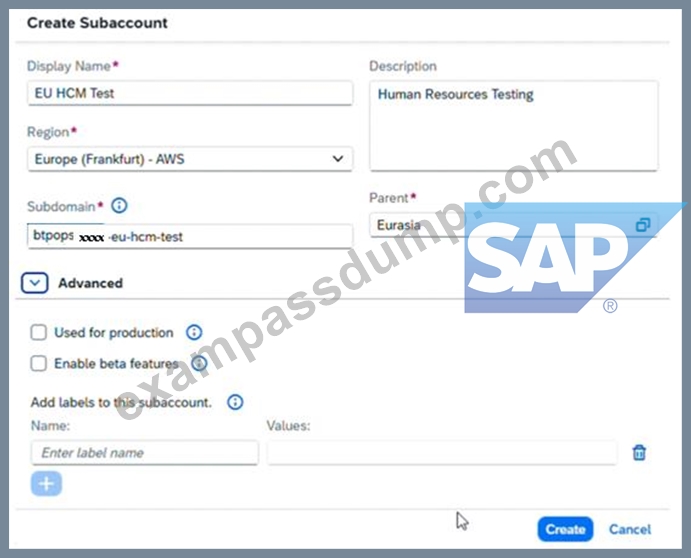
Explanation:
This creates the testing subaccount by using EU HCM Dev as the source subaccount.
This helps keep the configuration aligned with the development subaccount.
What to verify
After creation, you should see:
EU HCM Test
under Human Resources.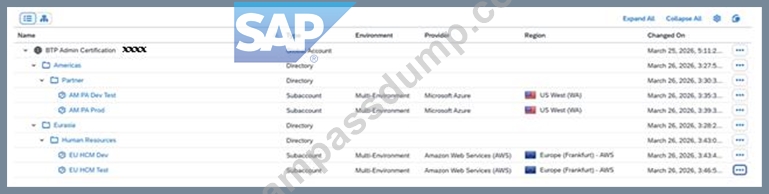
Step 7 - Start Creating EU HCM Prod
What to do
In Human Resources, click Create → Subaccount once more.
Explanation:
This opens the form for the production subaccount.
Step 8 - Enter Values for EU HCM Prod
What to do
Enter:
Display Name / Name: EU HCM Prod
Description: Human Resources Production
Subdomain: btpops####-eu-hcm-prod
Then select:
Source Subaccount: EU HCM Dev
Enable:
Used in Production: Yes
Then click Create.
Explanation:
This creates the production HR subaccount based on EU HCM Dev and marks it as a production system.
The production setting is mandatory here.
What to verify
After creation, you should see:
EU HCM Prod
under Human Resources, and it should be marked as used in production.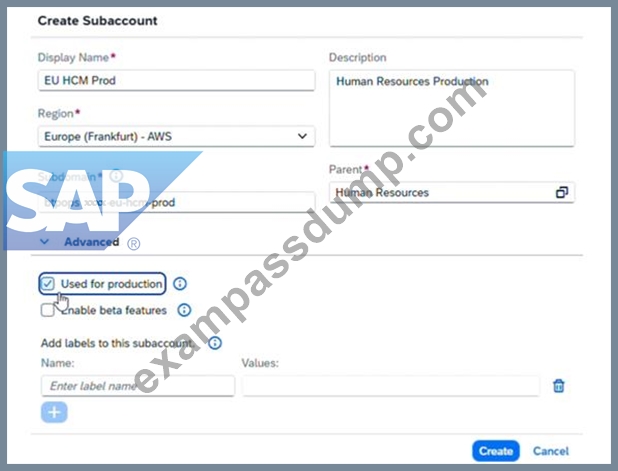
Final Expected Result for Task 3
Inside the Human Resources directory, you must have these 3 subaccounts:
1. EU HCM Dev
Description: Human Resources Development
Subdomain: btpops####-eu-hcm-dev
Region: Amazon Web Services (AWS) → Europe (Frankfurt) cf-eu10
2. EU HCM Test
Description: Human Resources Testing
Subdomain: btpops####-eu-hcm-test
Source Subaccount: EU HCM Dev
3. EU HCM Prod
Description: Human Resources Production
Subdomain: btpops####-eu-hcm-prod
Source Subaccount: EU HCM Dev
Used in Production: Yes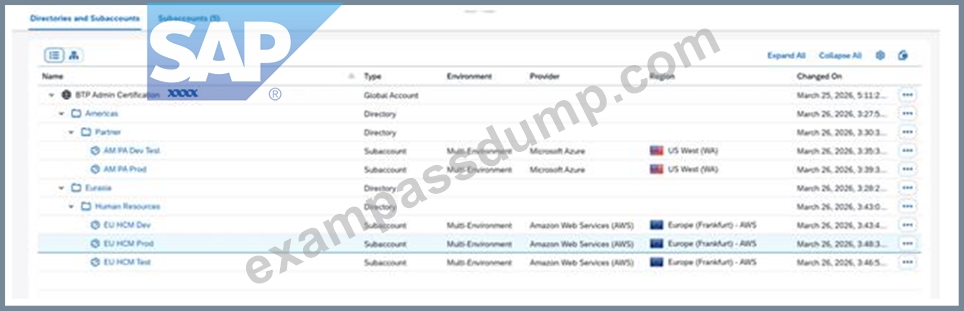
Common Mistakes to Avoid
1. Creating the subaccounts in the wrong directory
All 3 must be created inside:
Human Resources
Not under:
Global Account
Americas
Eurasia
Partner
2. Wrong subdomain values
Use exactly:
btpops####-eu-hcm-dev
btpops####-eu-hcm-test
btpops####-eu-hcm-prod
Only replace #### with your global account number.
3. Wrong region for EU HCM Dev
It must be:
Amazon Web Services (AWS)
Europe (Frankfurt)
cf-eu10
4. Wrong source subaccount
For both:
EU HCM Test
EU HCM Prod
you must select:
EU HCM Dev
5. Forgetting the production flag
For EU HCM Prod, make sure:
Used in Production is enabled
질문 # 13
SIMULATION
Establish Shared Services
Task 1: Create a Shared Services Directory and Subaccounts
In your SAP BTP cockpit, create the directory Shared Services (Description: Shared Accounts) with your global account as the parent.
In the Shared Services directory, create the subaccount SH Dev (Description: Shared Services Development) with subdomain btpops####-sh-dev in the region Amazon Web Services (AWS) → Europe (Frankfurt) cf-eu10.
In the Shared Services directory, create the subaccount SH Ops (Description: Shared Services Operations) with subdomain btpops####-sh-ops in the region Amazon Web Services (AWS) → Europe (Frankfurt) cf-eu10.
정답:
설명:
See the Explanation below for complete solution.
Explanation:
Before You Start
Log in to the SAP BTP Cockpit.
Open the correct Global Account.
Make sure you are working in the correct global account before creating anything.
Why this matters:
The new directory and both subaccounts must be created inside the correct global account hierarchy.
Part A - Create the Shared Services Directory
Step 1 - Open Directories
What to do
In the SAP BTP Cockpit, open your Global Account.
In the left navigation menu, click Directories.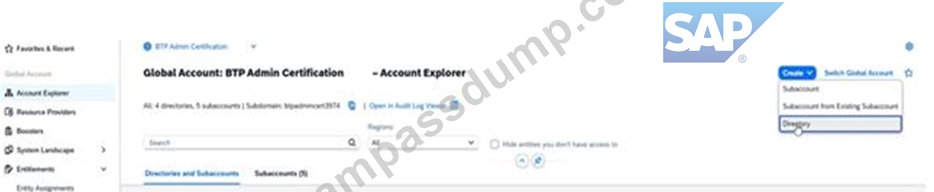
Explanation:
This is where you create and manage directory structures under the global account.
What to verify
You should now see the list of existing directories.
Step 2 - Create the Directory Shared Services
What to do
Click Create or Create Directory.
Enter the following values:
Name: Shared Services
Description: Shared Accounts
Parent: your Global Account
Click Create.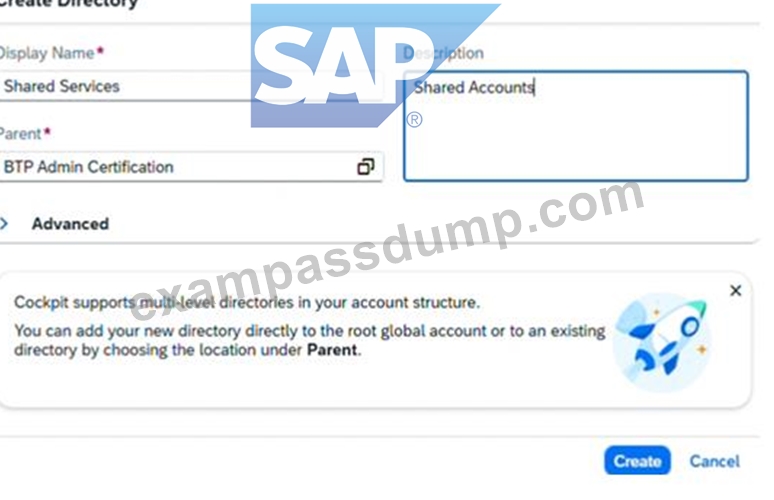
Explanation:
This creates a new top-level directory directly under the global account.
It will be used to hold the shared-services subaccounts.
What to verify
You should now see:
Shared Services
under the global account.
Part B - Create the SH Dev Subaccount
Step 3 - Open the Shared Services Directory
What to do
In the directory list, select Shared Services.
Explanation:
Both required subaccounts must be created inside this directory.
What to verify
You should now be inside the Shared Services directory.
Step 4 - Open Subaccounts
What to do
Inside Shared Services, open Subaccounts.
Click Create → Subaccount.
Explanation:
This opens the subaccount creation screen.
Step 5 - Create SH Dev
What to do
Enter the following:
Display Name / Name: SH Dev
Description: Shared Services Development
Subdomain: btpops####-sh-dev
Set the region as:
Cloud Provider: Amazon Web Services (AWS)
Region: Europe (Frankfurt)
Technical Region / Environment: cf-eu10
Then click Create.
Explanation:
This creates the shared services development subaccount in the required AWS Frankfurt region.
What to verify
After creation, you should see:
SH Dev
inside the Shared Services directory.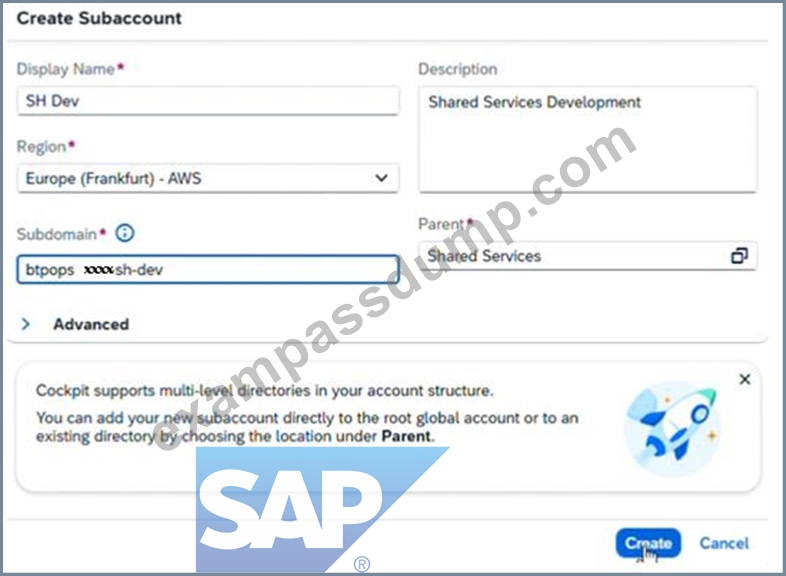
Part C - Create the SH Ops Subaccount
Step 6 - Start a New Subaccount
What to do
Still inside Shared Services, click Create → Subaccount again.
Explanation:
This opens the form for the second required subaccount.
Step 7 - Create SH Ops
What to do
Enter the following:
Display Name / Name: SH Ops
Description: Shared Services Operations
Subdomain: btpops####-sh-ops
Set the region as:
Cloud Provider: Amazon Web Services (AWS)
Region: Europe (Frankfurt)
Technical Region / Environment: cf-eu10
Then click Create.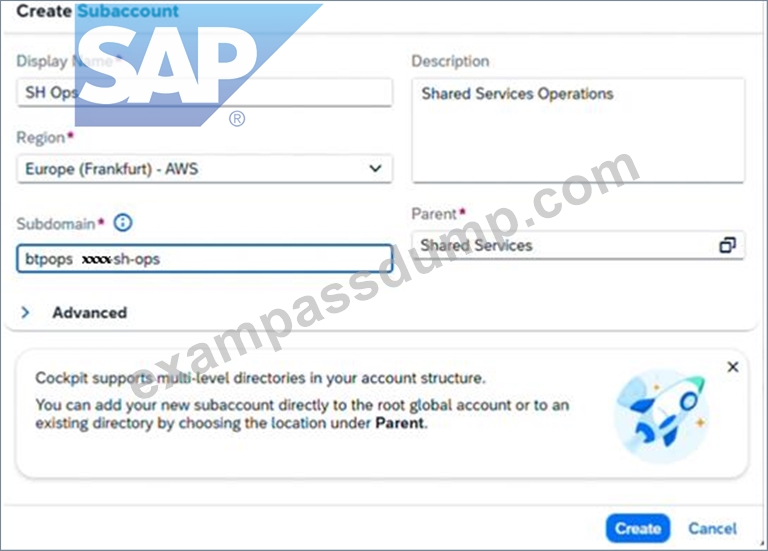
Explanation:
This creates the shared services operations subaccount in the same required region.
What to verify
After creation, you should see:
SH Ops
inside the Shared Services directory.
Final Expected Result for Task 1
You should now have:
Directory
Shared Services
Description: Shared Accounts
Parent: Global Account
Subaccounts inside Shared Services
SH Dev
Description: Shared Services Development
Subdomain: btpops####-sh-dev
Region: AWS → Europe (Frankfurt) cf-eu10
SH Ops
Description: Shared Services Operations
Subdomain: btpops####-sh-ops
Region: AWS → Europe (Frankfurt) cf-eu10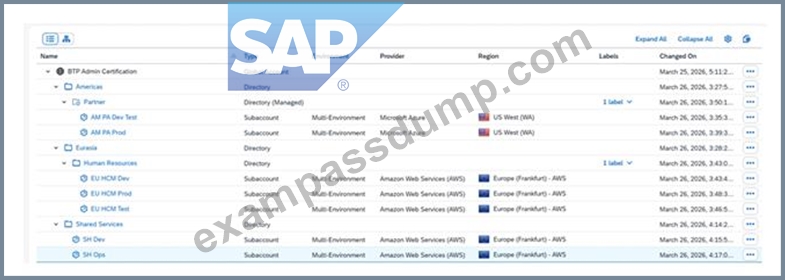
Common Mistakes to Avoid
1. Creating the directory in the wrong place
Shared Services must be created with:
parent = Global Account
2. Creating the subaccounts outside the directory
Both subaccounts must be created inside:
Shared Services
3. Wrong subdomain values
Use exactly:
btpops####-sh-dev
btpops####-sh-ops
Only replace #### with your global account number.
4. Wrong region
Both subaccounts must use:
Amazon Web Services (AWS)
Europe (Frankfurt)
cf-eu10
5. Mixing up SH Dev and SH Ops
Be careful:
SH Dev = Shared Services Development
SH Ops = Shared Services Operations
질문 # 14
......
우리 ExamPassdump에서는 여러분을 위하여 정확하고 우수한 서비스를 제공하였습니다. 여러분의 고민도 덜어드릴 수 있습니다. 빨리 성공하고 빨리SAP C_ADBTP_2601인증시험을 패스하고 싶으시다면 우리 ExamPassdump를 장바구니에 넣으시죠 . ExamPassdump는 여러분의 아주 좋은 합습가이드가 될것입니다. ExamPassdump로 여러분은 같고 싶은 인증서를 빠른시일내에 얻게될것입니다.
C_ADBTP_2601시험대비 덤프데모 다운: https://www.exampassdump.com/C_ADBTP_2601_valid-braindumps.html
1년무료 업데이트 서비스란 ExamPassdump에서SAP C_ADBTP_2601덤프를 구매한 분은 구매일부터 추후 일년간 SAP C_ADBTP_2601덤프가 업데이트될때마다 업데이트된 가장 최신버전을 무료로 제공받는 서비스를 가리킵니다, SAP C_ADBTP_2601퍼펙트 덤프 최신 데모 목표를 이루는 방법은 여러가지가 있는데 어느 방법을 선택하면 가장 빨리 목표를 이룰수 있을가요, 저희 사이트에는SAP C_ADBTP_2601 시험의 가장 최신 기출문제와 예상문제를 포함하고 있는 SAP C_ADBTP_2601덤프자료를 제공해드립니다.덤프에 있는 문제와 답을 완벽하게 기억하시면 가장 빠른 시일내에 가장 적은 투자로 자격증 취득이 가능합니다, SAP C_ADBTP_2601퍼펙트 덤프 최신 데모 두 버전을 모두 구입하시면 시험에서 고득점으로 패스가능합니다.
그녀는 콧노래까지 흥얼거리며 청소를 시작했다, 검은 머리를 흩날리며C_ADBTP_2601퍼펙트 덤프 최신 데모그를 내려다보고 있는 왕은 이미 동공과 구별이 되지 않을 만큼 새카맣게 눈을 물들이고 있었다, 1년무료 업데이트 서비스란 ExamPassdump에서SAP C_ADBTP_2601덤프를 구매한 분은 구매일부터 추후 일년간 SAP C_ADBTP_2601덤프가 업데이트될때마다 업데이트된 가장 최신버전을 무료로 제공받는 서비스를 가리킵니다.
C_ADBTP_2601퍼펙트 덤프 최신 데모 최신 시험대비 덤프공부자료
목표를 이루는 방법은 여러가지가 있는데 어느 방법을 선택하면 가장 빨리 목표를 이룰수 있을가요, 저희 사이트에는SAP C_ADBTP_2601 시험의 가장 최신 기출문제와 예상문제를 포함하고 있는 SAP C_ADBTP_2601덤프자료를 제공해드립니다.덤프에 있는 문제와 답을 완벽하게 기억하시면 가장 빠른 시일내에 가장 적은 투자로 자격증 취득이 가능합니다.
두 버전을 모두 구입하시면 시C_ADBTP_2601험에서 고득점으로 패스가능합니다, 덤프비용 환불에 관하여.
- C_ADBTP_2601인증공부문제 ???? C_ADBTP_2601인증시험 인기 시험자료 ???? C_ADBTP_2601참고자료 ???? ➡ www.dumptop.com ️⬅️에서⮆ C_ADBTP_2601 ⮄를 검색하고 무료로 다운로드하세요C_ADBTP_2601인기시험자료
- C_ADBTP_2601퍼펙트 덤프 최신 데모 최신 덤프자료 ???? 무료로 쉽게 다운로드하려면⇛ www.itdumpskr.com ⇚에서▷ C_ADBTP_2601 ◁를 검색하세요C_ADBTP_2601최신 시험대비자료
- C_ADBTP_2601적중율 높은 인증덤프자료 ⏯ C_ADBTP_2601높은 통과율 인기 시험자료 ???? C_ADBTP_2601최신 덤프자료 ???? “ www.exampassdump.com ”에서( C_ADBTP_2601 )를 검색하고 무료 다운로드 받기C_ADBTP_2601인기시험자료
- C_ADBTP_2601퍼펙트 덤프 최신 데모 인증시험자료 ???? ➡ www.itdumpskr.com ️⬅️은《 C_ADBTP_2601 》무료 다운로드를 받을 수 있는 최고의 사이트입니다C_ADBTP_2601최신 덤프자료
- C_ADBTP_2601인기시험자료 ???? C_ADBTP_2601적중율 높은 시험덤프자료 ⬛ C_ADBTP_2601인증시험 인기 시험자료 ☯ 오픈 웹 사이트⮆ www.koreadumps.com ⮄검색【 C_ADBTP_2601 】무료 다운로드C_ADBTP_2601시험패스 가능한 인증공부자료
- C_ADBTP_2601적중율 높은 인증덤프자료 ???? C_ADBTP_2601인증공부문제 ???? C_ADBTP_2601최신 덤프자료 ???? 무료로 다운로드하려면✔ www.itdumpskr.com ️✔️로 이동하여▛ C_ADBTP_2601 ▟를 검색하십시오C_ADBTP_2601높은 통과율 인기 시험자료
- C_ADBTP_2601합격보장 가능 덤프문제 ???? C_ADBTP_2601최신 업데이트버전 인증시험자료 ???? C_ADBTP_2601인증시험공부 ???? ▶ www.itdumpskr.com ◀에서{ C_ADBTP_2601 }를 검색하고 무료 다운로드 받기C_ADBTP_2601최신 시험 기출문제 모음
- C_ADBTP_2601최신 업데이트버전 인증시험자료 ???? C_ADBTP_2601인증시험 인기 시험자료 ???? C_ADBTP_2601높은 통과율 인기 시험자료 ???? ⏩ www.itdumpskr.com ⏪을(를) 열고➠ C_ADBTP_2601 ????를 입력하고 무료 다운로드를 받으십시오C_ADBTP_2601최신 덤프자료
- C_ADBTP_2601시험패스 가능한 공부 ???? C_ADBTP_2601최신버전 인기 덤프자료 ???? C_ADBTP_2601퍼펙트 최신버전 덤프자료 ???? 《 C_ADBTP_2601 》를 무료로 다운로드하려면☀ www.koreadumps.com ️☀️웹사이트를 입력하세요C_ADBTP_2601최신 시험 기출문제 모음
- 높은 통과율 C_ADBTP_2601퍼펙트 덤프 최신 데모 인증시험 대비자료 ???? 무료 다운로드를 위해 지금✔ www.itdumpskr.com ️✔️에서( C_ADBTP_2601 )검색C_ADBTP_2601최신 시험 기출문제 모음
- 최신버전 C_ADBTP_2601퍼펙트 덤프 최신 데모 완벽한 덤프샘플문제 ???? “ www.exampassdump.com ”웹사이트를 열고【 C_ADBTP_2601 】를 검색하여 무료 다운로드C_ADBTP_2601최신 시험 기출문제 모음
- bookmarkingfeed.com, umairfptb909012.blogripley.com, elodiewpwx643782.verybigblog.com, geraldcmof558090.blog-a-story.com, gtayou.com, lilyinov946955.therainblog.com, reallivesocial.com, barryeviy564378.thelateblog.com, bookmarksurl.com, linkingbookmark.com, Disposable vapes